

Simple summary:
- The target ratio (EPA > DHA): For strength and hypertrophy sports, favor a dominant EPA ratio (approximately 60/40). While DHA supports cognitive function, EPA (eicosapentaenoic acid) has the most direct anti-inflammatory effect on muscle fibers stressed by heavy training.
-
Recommended dosages: Current scientific literature and consensus guidelines (such as the ISSN) indicate that a daily intake of 1 to 2 g of total omega-3 fatty acids is the baseline. For optimized results on nerve recovery and strength, some expert protocols increase this to up to 3 g/day of EPA+DHA during intensive training cycles.
Comparison of the best omega-3s for bodybuilding [2026 Ranking]
| Rank | Brand | EPA (mg) | DHA (mg) | Total EPA+DHA (mg) | EPA/DHA ratio | Muscle verdict |
|---|---|---|---|---|---|---|
| 🥇 1 | SuperNutrition | 800 | 600 | 1400 | 57/43 | Solid EPA, excellent for recycling |
| 🥈 2 | Onatera | 600 | 400 | 1000 | 60/40 | Good ratio + good EPA |
| 🥉 3 | Novoma | 600 | 400 | 800 | 60/40 | Correct, but less concentrated. |
| 4 | Dynveo | 500 | 250 | 750 | 66/33 | Perfect sports ratio, average EPA |
| 5 | Inshape Nutrition | 331 | 221 | 552 | 60/40 | EPA too low |
Note: The dosages are those recommended by each brand for the dosage they recommend.
Why are omega-3s useful in bodybuilding?
In short: The benefits of omega-3s optimize
- muscle growth by stimulating the mTOR pathway
- They accelerate recovery thanks to their action on post-exercise inflammation.
- A high intake of EPA reduces cellular damage and protects your joints during intense workouts.
Gaining mass requires more than just protein. A 2023 review published in Nutrients [1] highlights that EPA and DHA improve the fluidity of your cell membranes . This boosts insulin sensitivity and activates the mTOR pathway, optimizing the use of leucine to build muscle.
Accelerate your nerve and muscle recovery
Heavy training generates micro-tears and an increase in creatine kinase in the blood. We know that omega-3 fatty acids act as architects of repair . By producing resolvins, they transform the initial inflammation into a phase of rapid tissue reconstruction.
Preserve your mobility and joint health
Your joints absorb every repetition. These fatty acids decrease the production of pro-inflammatory cytokines around the cartilage. This action reduces post-workout stiffness and ensures consistent mobility, even during your most demanding strength cycles.
Scientific evidence: A 2021 meta-analysis (Kyriakidou et al.) [2] confirms that supplementation significantly reduces creatine kinase , the blood marker of muscle damage. After intense squat or lunge sessions, the athletes tested reported significantly less perceived pain, facilitating a rapid return to training.
Why choose these lipids for your overall health?
Beyond performance, incorporating these supplements stabilizes your heart rhythm and supports your cognitive function . In bodybuilding, a strong heart ensures better oxygen transport, allowing you to maintain a high intensity throughout your workout.

What EPA/DHA ratio is best for bodybuilding?
In short: The optimal ratio for bodybuilding favors EPA over DHA (ratio close to 1.5 to 1). This emphasis on EPA allows for direct targeting of muscle recovery and limits inflammatory markers associated with intense physical exertion.
The body uses fatty acids differently. While DHA supports your vision, EPA acts as a direct lever against cellular damage. A daily dose rich in EPA promotes tissue repair and helps limit fatigue accumulated during your strength training.
A balance that supports protein synthesis
A ratio too high in DHA will benefit your brain health , although it will be less effective for your muscles. We recommend looking for supplements where EPA makes up about 60% of the total dose to stimulate your anabolic receptors after a strenuous workout.
Maximize your results with Omega 3 Epax SuperNutrition
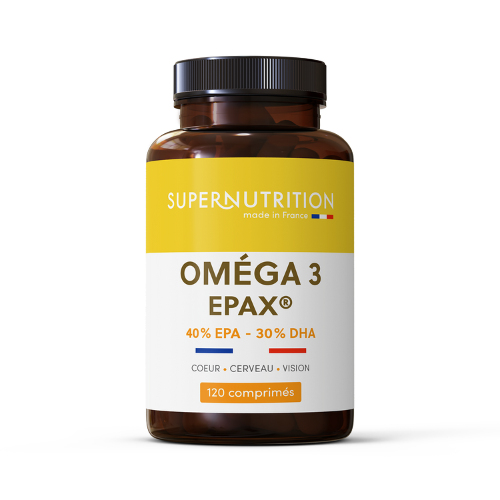
Our expert solution
We developed our Omega 3 Epax to meet the needs of athletes. This product provides the ideal ratio with exceptional purity thanks to its triglyceride form.
See our Omega 3Here's what our omega-3 contains per 4 capsules:
- Total Omega-3: 1400 mg
- EPA: 800 mg
- DHA: 600 mg
So 1 capsule = 200 mg EPA + 150 mg DHA.
According to the official position of the ISSN (International Society of Sports Nutrition) published in 2025 (PMID: 39810703) [3], omega-3 supplementation is no longer an option for the athlete: a daily intake of at least 1,000 to 2,000 mg of total omega-3 / day with dominant EPA is necessary to observe a real impact on contractile strength and fiber protection.
With our product:
- 4 capsules = 1600 mg omega-3 - within the "effective" range of sports studies
- 6 capsules = 2400 mg omega-3 - high end of the protocol range
How to choose the ideal omega-3 for sports and bodybuilding? (Expert criteria)
Choosing your omega-3 capsules requires careful attention to the molecular structure and freshness of the oil. For athletes, the raw quality determines the actual effect on performance and recovery. Here's your checklist to help you make the right choice.
Your quality checklist:
- Triglyceride (TG) form: For up to 70% greater absorption than synthetic versions.
- TOTOX index < 5: The guarantee of fresh and unoxidized fish oil.
- EPA concentration: Minimum 400 mg per capsule to act on inflammation related to bodybuilding.
- Certified Labels: Look for Epax® or IFOS markings for purity and sustainable fishing.
Triglycerides vs Ethyl Esters: Which form is best for absorption?
Most low-quality oils use Ethyl Esters (EE), a less expensive synthetic form. However, our metabolism better recognizes the natural form, triglycerides (TG) . This offers 70% greater bioavailability , allowing your body to quickly integrate fatty acids into your muscle fibers.
The TOTOX rule: How to avoid expired fish oil?
TOTOX measures the total oxidation of your supplement. Oxidized oil becomes ineffective and can even be counterproductive to your health. For optimal athletic performance, we recommend demanding a score below 5 , well below current European standards, to guarantee absolute freshness and the absence of a rancid taste.
EPA vs DHA dosage for bodybuilding
Intensive weight training generates significant oxidative stress. Prioritize a high EPA to DHA ratio . Eicosapentaenoic acid (EPA) has the most beneficial properties for reducing chronic inflammation. A robust daily EPA intake helps accelerate your return to the gym and maintain consistent progress.
Research Focus 2023-2026: The role of omega-3 in cell regeneration
In short: A 2023 scientific review proves that omega-3 fatty acids activate the satellite cells of your muscles . These "worker cells" rebuild damaged fibers to create denser, stronger muscle tissue after your intense workouts.
A major review published in the journal Nutrients (Nov. 2023) [1] reveals an action that goes beyond simply reducing muscle soreness. EPA and DHA supplementation targets deep regeneration by optimizing the activation of muscle satellite cells.
These cells act like true workers, rebuilding fibers damaged by heavy training. By promoting this natural repair process, you accelerate your recovery while fostering the development of denser muscle in the long term.
📌 The essentials in 3 points
- The target ratio: Favor EPA > DHA (ideal ratio of 60/40) to maximize the anti-inflammatory effect on muscles.
- The right dosage: Aim for 1 to 2 g of total omega-3 (EPA + DHA combined) per day according to the scientific literature on sport.
- The objectives: Accelerated recovery, less post-workout pain (DOMS) and better joint protection.
Frequently asked questions about omega-3s and sports
Do omega-3s promote muscle mass gain?
Yes, indirectly. They improve the sensitivity of your insulin receptors and activate the mTOR pathway. This allows your body to better utilize amino acids from your protein to build muscle. It's not a miracle product, but a lever for optimizing your anabolism.
Is it possible to consume too much omega-3 during bodybuilding?
The EFSA (European Food Safety Authority) sets a safe limit of 5g of EPA + DHA per day. Exceeding this limit carries a risk of blood thinning. Consuming 2 to 3g per day provides all the benefits without any risk to your health.
How much EPA and DHA is needed for bodybuilding?
To achieve a systemic effect on recovery and inflammation, aim for 1 to 2 grams of combined EPA and DHA per day. A lower dosage is still beneficial for heart health but is often insufficient to meet the physical demands of a regular athlete.
Omega-3 and Whey: a dangerous combination?
Not at all, it's actually a powerful combination. Whey provides the building blocks (amino acids) while omega-3s prepare the body by making your cell membranes more flexible. Consuming them together in a meal also facilitates fat absorption thanks to the other nutrients present.
Is krill oil superior to fish oil?
Krill oil contains phospholipids that promote absorption, but it remains very expensive and less concentrated in EPA/DHA. To achieve the dosages required for bodybuilding, fish oil in triglyceride form (such as Omega 3 Epax) offers a much higher price-to-performance ratio and effectiveness.
Are plant-based omega-3s (ALA) sufficient for sports?
Unfortunately not. ALA from flaxseed or walnuts must be converted by the body into EPA and DHA. The conversion rate is less than 10%. To protect your joints and boost your recovery, you need the already active forms found in seafood or algae.
What are the effects of omega-3 on muscle strength?
Studies published by the ISSN between 2024 and 2025 show an improvement in neuromuscular conduction. Omega-3 fatty acids help nerve signals travel faster to your muscle fibers. This allows you to increase the efficiency of your explosive movements and maintain better contractile strength.
Our related articles:
Security Council
Before starting any treatment, seek the advice of your doctor.
[1] Effects of Omega-3 Fatty Acid Supplementation on Skeletal Muscle Mass and Strength in Adults: A Systematic Review - PubMed, 2023.
[2] Omega-3 Fatty Acids and Exercise-Induced Muscle Damage: A Meta-Analysis - PubMed, 2021.
[3] International Society of Sports Nutrition Position Stand: Long-Chain Omega-3 Polyunsaturated Fatty Acids - PubMed, 2025.


