

Omega-3s EPA and DHA primarily act on triglycerides, not directly on LDL cholesterol. Their role in lipid balance is real, but often misunderstood. Here's what recent studies say — and what you can concretely expect from them.
Key takeaways
- Omega-3s (EPA + DHA) can reduce blood triglycerides by 15 to 30%, an effect validated by EFSA starting from 2 g/day.
- They have no significant effect on LDL cholesterol. DHA may even slightly increase it, according to a systematic review published in Frontiers in Nutrition (Choi & Calder, 2024).
- High-dose purified EPA (4 g/day) reduced cardiovascular events by 25% in the REDUCE-IT clinical trial (Bhatt et al., NEJM, 2019).
- In France, over 85% of adults have insufficient omega-3 intake, according to the ANSES 2015 report.
In summary: omega-3s do not strictly "lower cholesterol." They improve your overall lipid profile by targeting triglycerides and protecting your arteries through anti-inflammatory mechanisms.
Omega-3s and cholesterol: what do studies really say?
Omega-3s EPA (eicosapentaenoic acid) and DHA (docosahexaenoic acid) are polyunsaturated fatty acids found in fatty fish and some vegetable oils. They are often credited with an "anti-cholesterol" effect. The scientific reality is more nuanced.
Their main action is on triglycerides — a form of blood fat distinct from cholesterol. A dose-response meta-analysis published in the Journal of the American Heart Association showed that EPA + DHA intake reduces triglycerides and non-HDL-cholesterol almost linearly with dose.
Regarding LDL cholesterol (known as "bad cholesterol"), the data is clear: omega-3s have no significant reducing effect. According to the same meta-analysis, the dose-response curve for LDL-C even shows a slight increase around 1.75 g/day of EPA + DHA.
Summary table: effect of omega-3s on blood lipids
| Lipid marker | Effect of omega-3s (EPA + DHA) | Level of evidence |
|---|---|---|
| Triglycerides | ↓ 15 to 30% reduction | High (validated EFSA claim) |
| LDL cholesterol | ↔ No significant effect (slight increase possible with DHA) | Moderate |
| HDL cholesterol | ↑ Slight increase | Moderate |
| Non-HDL-C | ↓ Moderate reduction | Moderate |
| Total cholesterol | ↓ Modest reduction | Moderate |
Sources: JAHA, dose-response meta-analysis; Zhang et al., Food Science & Nutrition, 2025.
EPA or DHA: which works best for your lipid profile?
Not all omega-3s are equally effective against cholesterol. EPA and DHA have differentiated effects on lipid markers — a point that most general public articles omit.
A 2024 systematic review by Choi and Calder, published in Frontiers in Nutrition, compared the effects of pure EPA versus pure DHA (at doses ≥ 2 g/day) across 9 randomized clinical trials:
- Triglycerides: both reduce them, with a slight advantage for DHA.
- LDL-cholesterol: EPA does not increase it. DHA can lead to a moderate increase in LDL-C.
- HDL-cholesterol: DHA tends to increase it more than EPA.
Did you know?
EPA integrates into cell membranes and stabilizes atheroma plaques. DHA, with its longer carbon chain, increases membrane fluidity. These distinct mechanisms explain why their effects on LDL differ. (Khan et al., eClinicalMedicine, 2021)
This distinction has a practical implication: if you want to act on your lipid profile without risking an increase in LDL, a supplement rich in EPA or with a high EPA/DHA ratio should be favored.
How do omega-3s reduce triglycerides?
Omega-3s act on triglycerides through several well-documented biological mechanisms. They reduce the hepatic production of VLDL (very low-density lipoproteins), stimulate the oxidation of fatty acids in the liver, and limit lipogenesis — i.e., the manufacture of new fats.
The effect is dose-dependent. According to the American Heart Association (AHA, 2019), at a pharmacological dose of 4 g/day, EPA + DHA formulations reduce triglycerides by 30% or more in people with severe hypertriglyceridemia.
A 2025 meta-analysis of 20 studies and 1,685 participants with coronary heart disease confirmed a significant reduction in triglycerides with omega-3 supplementation (SMD = -0.25, p = 0.024). This same meta-analysis also noted a reduction in total cholesterol. (Zhang et al., Food Science & Nutrition, 2025)
At what dose for what effect?
| Dose EPA + DHA / day | Expected effect | Reference |
|---|---|---|
| 250 mg | Normal heart function | EFSA approved claim |
| 2 g | Maintenance of normal triglyceride levels | EFSA approved claim |
| 3 g | Maintenance of normal blood pressure | EFSA approved claim |
| 4 g (pharmacological dose) | TG reduction ≥ 30% (hypertriglyceridemia) | AHA Science Advisory, 2019 |
Reminder: EFSA recommends not exceeding 5 g/day of DHA + EPA in supplementation. High doses (≥ 3 g/day) require medical advice.
The REDUCE-IT trial: a major advance for cardiovascular prevention
The REDUCE-IT trial remains the most solid clinical reference to date on the link between omega-3s and cardiovascular risk. Published in 2019 in the New England Journal of Medicine, it followed 8,179 high-risk cardiovascular patients, already on statins, for nearly 5 years.
Participants received 4 g/day of icosapent ethyl (a purified form of EPA) or a placebo. The results:
- -25% of major cardiovascular events (heart attack, stroke, cardiovascular death, revascularization, unstable angina).
- -20% of cardiovascular deaths.
- Benefit observed regardless of the triglyceride level reached, suggesting mechanisms beyond simple triglyceride lowering (anti-inflammatory, plaque stabilization).
⚠️ Scientific nuance
The STRENGTH trial (2020), which tested an EPA + DHA mixture (4 g/day), showed no reduction in cardiovascular events. This divergence fuels the debate: is it EPA alone that makes the difference? Could DHA mitigate its benefits? Did the placebo (mineral oil in REDUCE-IT vs corn oil in STRENGTH) also play a role? The question remains open.
What we can remember: omega-3 supplementation, and particularly EPA, is part of a global strategy for cardiovascular protection — complementary to a balanced diet, physical activity and, if necessary, appropriate medical treatment.
Why most French people lack omega-3s
According to the ANSES report published in 2015, omega-3 intake in the French population is far below recommendations. The figures are clear:
- 99% of adults have insufficient ALA (alpha-linolenic acid) intake.
- 89% for EPA.
- 85% for DHA.
The average DHA intake is 137 mg/day, and EPA intake is 102 mg/day — while ANSES recommends 250 mg/day for each. The French diet, historically oriented towards saturated fats (butter, cured meats, cheese) and sunflower oil (rich in omega-6s), does not meet these needs.
The average omega-6/omega-3 ratio in France is around 7 to 1, while ANSES recommends a ratio below 5. This imbalance promotes a chronic pro-inflammatory state, which contributes to the development of atherosclerosis and the degradation of the lipid profile.
How to concretely rebalance your intake?
- Consume fatty fish (sardines, mackerel, anchovies) at least twice a week.
- Favor rapeseed oil or flaxseed oil for seasoning (ALA sources).
- If your fish consumption is insufficient, quality omega-3 supplementation is a relevant option to fill this gap.
Which omega-3 supplement to choose to act on your lipid profile?
The quality of an omega-3 supplement is not limited to the dosage displayed. Three criteria determine its real effectiveness:
1. The concentration of EPA and DHA. Many capsules contain 1,000 mg of fish oil, but only 300 mg of EPA + DHA. Aim for at least 60% concentration for an effective intake.
2. The galenic form. Omega-3s in triglyceride (TG) form are better absorbed than ethyl esters (EE). TG bioavailability is approximately twice as high.
3. The oxidation index (TOTOX). Omega-3s are very sensitive to rancidity. A low TOTOX index (< 10, ideally < 7) guarantees the freshness of the oil. The standard allows up to 26 — a far too permissive threshold.
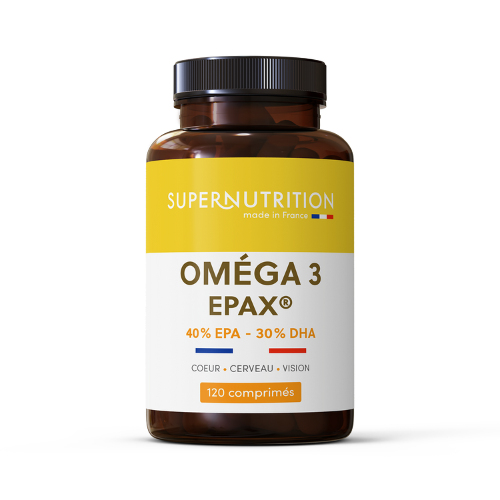
Our expert solution
At SuperNutrition, our Omega 3 Epax® meets these three criteria. The oil comes from small wild fish (sardines, anchovies), is Friend of the Sea certified, concentrated in triglyceride form with a TOTOX index below 7. The Epax® label — a global Norwegian reference — guarantees advanced purification (heavy metals, PCBs, dioxins eliminated) and a high concentration of EPA and DHA.
View our Omega 3The omega-3 index: the marker your standard lipid panel does not measure
Your standard blood test measures total cholesterol, LDL, HDL, and triglycerides. But it omits a marker that is increasingly studied: the omega-3 index.
The omega-3 index corresponds to the percentage of EPA + DHA in the red blood cell membrane. It reflects your omega-3 status over the last 2 to 3 months — much like HbA1c for blood sugar. This concept was proposed by researchers Harris and Von Schacky.
An omega-3 index below 4% is associated with an increased cardiovascular risk. An index above 8% is considered protective. The French population is mostly below 4%, which partly explains the high prevalence of cardiovascular diseases.
This marker has practical interest: it objectively verifies whether your diet or supplementation covers your actual needs for EPA and DHA — beyond the simple dosage written on the bottle. Some specialized micronutrition laboratories already offer this test in France.
💡 Practical advice
If you have been consuming omega-3s for several months without noticing an improvement in your lipid panel, an omega-3 index measurement can help verify that EPA and DHA are well absorbed and integrated. The choice of a supplement in triglyceride form (and not ethyl esters) significantly improves this absorption.
Frequently asked questions about omega-3s and cholesterol
Can omega-3s replace statins?
No. Omega-3s and statins act on different targets. Statins reduce hepatic production of LDL cholesterol. Omega-3s primarily target triglycerides. The REDUCE-IT trial was conducted in patients already on statins. Omega-3 supplementation can be a complement to existing treatment, never a replacement without medical advice.
Should I take omega-3s if my cholesterol is normal?
The benefits of omega-3s extend beyond cholesterol management. EFSA has validated their contribution to normal heart function (250 mg/day of EPA + DHA). Given that 85% of French people have insufficient intake, supplementation may be relevant even in the absence of dyslipidemia — for the heart, brain, and vision.
Are flaxseed oil or nuts enough?
These sources provide ALA, a plant-based omega-3. The problem: the conversion rate of ALA to EPA is very low (1 to 4%), and conversion to DHA is almost zero. For a significant action on triglycerides and the lipid profile, direct intake of EPA and DHA (via fatty fish or supplementation) remains the most effective way.
Do omega-3s have side effects on cholesterol?
DHA, at high doses, can cause a slight increase in LDL cholesterol in some people. This is why formulations rich in EPA (or with an EPA > DHA ratio) are often preferred in a lipid management context. At usual supplementation doses (250 to 500 mg/day of EPA + DHA), this effect remains marginal.
How long does it take to see an effect on the lipid panel?
Clinical studies show measurable effects on triglycerides after 8 to 12 weeks of regular supplementation. The omega-3 index takes about 3 months to reflect a change in intake. Regularity is more decisive than the one-off dose.
Can you take too many omega-3s?
EFSA considers that intakes of up to 5 g/day of DHA + EPA in supplementation do not pose a safety problem for adults. Beyond that, medical monitoring is recommended — particularly due to an increased risk of bleeding at very high doses. The FDA sets a similar threshold of 3 g/day without medical supervision.
What is the difference between fish omega-3s and algal omega-3s?
Both provide DHA. Algal omega-3s are a vegan alternative, but they often contain little EPA. For optimal action on triglycerides and cardiovascular protection, fish oil formulations (combined EPA + DHA) currently offer the best benefit/concentration ratio.
Our related articles:
- Omega-3s and sleep
- Omega-3s and gut
- Omega-3s and bodybuilding
- Omega-3s and depression
- Omega-3s and the brain
Cited Sources
- Bhatt DL, Steg PG, Miller M, et al. “Cardiovascular Risk Reduction with Icosapent Ethyl for Hypertriglyceridemia.” New England Journal of Medicine, 2019. Link
- Choi GY, Calder PC. “The differential effects of eicosapentaenoic acid and docosahexaenoic acid on cardiovascular risk factors: an updated systematic review.” Frontiers in Nutrition, 2024. Link
- Zhang et al. “Effects of Omega‐3 Fatty Acids Intake on Lipid Metabolism and Plaque Volume in Patients With Coronary Heart Disease.” Food Science & Nutrition, 2025. Link
- Skulas-Ray AC, et al. “Omega-3 Fatty Acids for the Management of Hypertriglyceridemia: A Science Advisory From the AHA.” Circulation, 2019. Link
- EPA + DHA and lipids dose-response meta-analysis. Journal of the American Heart Association. Link
- Khan SU, et al. “Effect of omega-3 fatty acids on cardiovascular outcomes: A systematic review and meta-analysis.” eClinicalMedicine, 2021. Link
- ANSES. “Fatty acid intake of the population living in France and comparison with ANCs.” 2015 Report. Link
- EFSA. Authorized health claims for EPA/DHA. Link
This article is informative and does not replace medical advice. Consult your doctor or pharmacist before changing your supplementation, especially if you are undergoing lipid-lowering treatment.


