

Key Takeaways:
- DHA and EPA are the two omega-3s directly active in the brain: one structures neuronal membranes, the other regulates brain inflammation.
- Fatty fish (salmon, mackerel, herring, sardines) are the only reliable dietary sources of bioavailable DHA and EPA for the brain.
- Plant-based ALA (flax, walnuts, rapeseed) converts to DHA at less than 5% — insufficient on its own to meet brain needs at any age.
- The supplement's molecular form (triglycerides TG, rTG, or ethyl esters EE) directly affects its absorption and actual effectiveness.
Omega-3 and the brain: the direct answer
The benefits of omega-3s — DHA (docosahexaenoic acid) and EPA (eicosapentaenoic acid) — directly contribute to the functioning and structure of the brain. DHA makes up neuronal membranes and determines their fluidity. EPA regulates brain inflammation and influences mood.
The EFSA (European Food Safety Authority) officially recognizes that DHA contributes to the maintenance of normal brain function, at a rate of 250 mg of DHA per day for an adult.
| Omega-3 | Role in the brain | Main dietary source |
|---|---|---|
| DHA | Structure of synaptic membranes, neuronal fluidity, memory | Fatty fish, supplements, algae |
| EPA | Regulation of neuroinflammation, mood, concentration | Fatty fish, supplements |
| ALA | Precursor only — DHA conversion less than 5% | Flax, walnuts, rapeseed (plant-based) |
DHA and EPA: two fatty acids, two distinct roles in the brain
DHA and EPA belong to the same family of long-chain omega-3s, but their mechanisms of action in the brain differ. Understanding this distinction helps in choosing the right intake based on one's goals.
| Criterion | DHA (docosahexaenoic acid) | EPA (eicosapentaenoic acid) |
|---|---|---|
| Main role | Structural — integrated into membrane phospholipids | Functional — regulation of neuroinflammation |
| Concentration in the brain | Very high (main PUFA of gray matter) | Low in tissue, active via its metabolites |
| Cognitive action | Memory, learning, processing speed | Mood, concentration, stress resilience |
| Validated EFSA claim | Maintenance of normal brain function | Maintenance of normal blood triglyceride concentration |
DHA, a structural component of neurons
DHA represents the majority of polyunsaturated fatty acids in the brain's gray matter. Integrated into the membrane phospholipids of neurons, it determines the fluidity of synaptic membranes — a property directly linked to the speed and quality of nerve signal transmission.
Without sufficient DHA, neurons incorporate other less fluid fatty acids into their membranes. Interneuronal communication is altered, with observable effects on memory and cognitive functions. This mechanism is documented in the scientific literature on the neurobiology of membrane lipids.
EPA, a modulator of brain inflammation
EPA is poorly stored in brain tissue, but its metabolites — resolvins and protectins — actively work to resolve neuroinflammation. Chronic neuroinflammation is associated with neurodegenerative diseases, accelerated brain aging, and mood disorders.
Epidemiological data observe a link between low plasma EPA levels and a higher prevalence of depressive symptoms. These associations do not constitute direct causal proof, but they form the basis of many nutritional recommendations for mental health.
At every stage of life, omega-3s have a specific role for the brain
| Life stage | Role of omega-3s in the brain | Priority fatty acid |
|---|---|---|
| Fetus / Infant | Brain construction, myelination, retinal development | DHA |
| Child / Adolescent | Brain maturation, synaptic plasticity, emotional balance | DHA + EPA |
| Adult | Maintenance of cognitive functions, memory, concentration, mood | DHA + EPA |
| Senior (60+) | Neuroprotection, slowing cognitive decline | DHA + EPA |
From fetus to infant: brain construction
The fetal brain accumulates DHA at a sustained rate during the third trimester of pregnancy and the first months of life. EFSA officially recognizes that maternal DHA intake contributes to the normal brain development of the fetus and breastfed infant. Pregnant women are advised to consume an additional 200 mg of DHA per day as a minimum.
A DHA deficiency during this period can affect synapse formation and axon myelination, two crucial processes for the future quality of the nervous system (source: Pudmed, 2016).
Adolescence: a critical window confirmed by INSERM
Researchers from INSERM (Unit 901, Marseille) and INRA (UMR 1256, Bordeaux) have shown that a diet low in omega-3s since adolescence reduces DHA levels in the prefrontal cortex and nucleus accumbens. The result in adulthood: anxiety-like behaviors, decreased cognitive functions, and impaired two elementary forms of synaptic plasticity. The study is published in The Journal of Neuroscience — DOI: 10.1523/JNEUROSCI.3516-16.2017.
The prefrontal cortex — involved in decision-making, executive control, and reasoning — and the nucleus accumbens — a regulator of reward and emotions — are the two regions most affected by this early deficiency.
Adult: memory, concentration, mood
In adults, the brain maintains more than it builds. Omega-3s ensure the renewal of membrane phospholipids and participate in the production of neurotransmitters involved in mood — serotonin and dopamine in particular. Regular intake of DHA and EPA supports cognitive functions as part of a balanced diet and lifestyle.
Seniors: neuroprotection and cognitive decline
After age 60, oxidative stress and background neuroinflammation gradually increase. Omega-3s contribute to neuroprotection by maintaining the fluidity of neuronal membranes and modulating inflammatory pathways via EPA metabolites.
Epidemiological data associate regular consumption of fatty fish with a reduced risk of cognitive decline. These associations do not allow for a direct causal effect, but they guide nutritional recommendations for this age group.
What food sources provide omega-3s beneficial for the brain?
For the brain, only DHA and EPA are directly usable by neurons. Marine sources are the only ones to provide significant amounts. Plants provide ALA, a precursor whose conversion to DHA is biologically very limited.
Fatty fish: the best sources of DHA and EPA
| Food (100 g cooked) | Estimated EPA + DHA |
|---|---|
| Mackerel | ~2,200 mg |
| Herring | ~2,000 mg |
| Atlantic salmon (farmed) | ~1,800 mg |
| Sardine | ~1,400 mg |
| Bluefin tuna | ~1,300 mg |
Two servings of fatty fish per week can meet the daily dose recommended by EFSA. In practice, a single 100 g serving of mackerel provides approximately 8 times the minimum daily dose of DHA recognized for normal brain function.
Plant sources: ALA, a precursor but insufficient alone for the brain
| Plant source | ALA content | DHA conversion (estimation) |
|---|---|---|
| Flaxseed oil | ~53% of fatty acids | Less than 5% |
| Chia seeds | ~18% | Less than 5% |
| Walnuts | ~9% | Less than 5% |
| Rapeseed oil | ~9% | Less than 5% |
The conversion rate of ALA to DHA in humans is less than 5%, and even lower in men than in women. For people following a vegan diet, microalgae oil (a direct source of non-marine DHA) is the nutritionally consistent alternative.
Should you take an omega-3 supplement for your brain?
The answer depends on your dietary habits. Two servings of fatty fish per week can cover the minimum EPA+DHA needs for an adult. In practice, a large part of the French population does not reach this threshold according to ANSES consumption data.
- Little or no fatty fish in the diet: omega-3 supplementation directly compensates for the dietary deficiency.
- Pregnancy or breastfeeding: an additional intake of 200 mg of DHA per day is recommended by EFSA in addition to the baseline intake.
- Strict vegan or vegetarian diet: ALA sources alone do not cover DHA needs; a microalgae oil supplement is indicated.
- Seniors (60+): the metabolic conversion of ALA to DHA decreases with age, making preformed intake more relevant.
The quality of the supplement determines its actual effectiveness. Three criteria help distinguish a superior quality product: the effective concentration of EPA+DHA per dose, the molecular form (TG, rTG, or EE — see next section), and purity guarantees (absence of heavy metals, PCBs, and dioxins).
Our expert solution
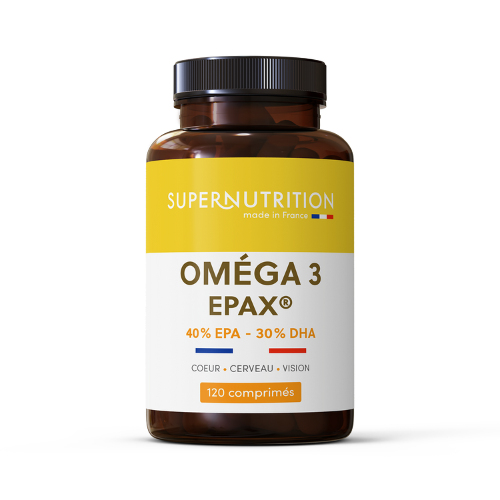
SuperNutrition's Omega-3 EPAX® is formulated from EPAX® certified fish oil — a benchmark Norwegian raw material, recognized for its high concentration of EPA and DHA and strict contaminant controls. A traceable option for targeted and controlled intake.
View our Omega 3Bioavailability of omega-3s: why the molecular form changes everything
The EPA+DHA content displayed on the label is not the only criterion to examine. The molecular form of the supplement directly determines the amount actually absorbed by the body — a parameter rarely explained on general public packaging.
Did you know?
Crude fish oils contain omega-3s in the form of natural triglycerides (TG). To achieve high concentrations of EPA+DHA, manufacturers convert these oils into ethyl esters (EE) during the concentration process. This transformation improves the final content but reduces intestinal absorption on an empty stomach.
Re-esterification — a process that reconstitutes the TG structure after concentration — produces re-esterified triglycerides (rTG), which combine high concentration and good bioavailability.
| Molecular form | Bioavailability | Optimal absorption conditions | Product type |
|---|---|---|---|
| Natural triglycerides (TG) | Good (reference) | With or without food | Low-concentrated oils |
| Ethyl esters (EE) | Reduced on an empty stomach | With a high-fat meal (mandatory) | Majority of concentrated supplements |
| Re-esterified triglycerides (rTG) | Superior to EE | Flexible | Premium ranges — e.g. EPAX® |
| Phospholipids (krill) | Very good | With or without food | Krill oil |
Regardless of the chosen form, taking your omega-3 supplement with a meal containing fats systematically improves absorption. For ethyl ester (EE) products, this rule is not a recommendation, it is a condition for effectiveness.
What dose of omega-3 for the brain? Official recommendations
Recommendations vary according to reference organizations and the person's profile. Here are the verifiable guidelines available in 2026.
| Profile | Recommended dose | Source |
|---|---|---|
| Healthy adult | 250 mg DHA/day minimum | EFSA, EU Regulation No 432/2012 |
| Pregnant / breastfeeding woman | 250 mg + 200 mg additional DHA = 450 mg/day | EFSA, EU Regulation No 432/2012 |
| Adult (cognitive objective — clinical studies) | 500 to 1,000 mg EPA+DHA/day | Doses used in study protocols (source to be verified) |
| Senior (60+) | 500 to 1,000 mg EPA+DHA/day | Nutritional recommendations — scientific literature (source to be verified) |
The 250 mg/day dose corresponds to the threshold for benefiting from the EFSA claim on normal brain function. Clinical studies on cognition, memory, or neuroprotection generally use higher doses, between 500 and 2,000 mg of EPA+DHA per day.
ANSES also recommends rebalancing the omega-6/omega-3 ratio in the daily diet. Reducing the intake of linoleic acid (sunflower oil, corn, margarine) and increasing quality omega-3 sources helps to fall below the recommended 5:1 ratio — an objective consistent with brain and cardiovascular health.
FAQ — Omega-3 and the brain: frequently asked questions
Do omega-3s really improve memory?
DHA contributes to the maintenance of normal brain function, including memory processes — this is a claim officially recognized by EFSA. Documented effects mainly concern the maintenance and protection of existing cognitive functions. People with a DHA deficiency seem to respond more to supplementation.
What is the difference between DHA and EPA for the brain?
DHA is structural: it composes neuronal membranes and represents the majority of polyunsaturated fatty acids in gray matter. EPA is functional: its metabolites (resolvins, protectins) regulate neuroinflammation and seem to act on mood and stress resilience. Both fatty acids act synergistically; this is why most studies and supplements combine them.
Are plant-based omega-3s (ALA) sufficient for the brain?
No. The conversion rate of ALA (flaxseeds, walnuts, rapeseed oil) to DHA is less than 5% in humans, and even lower in men. For a direct effect on the brain, an intake of preformed DHA and EPA — via fatty fish or a dietary supplement — is necessary. Vegans can turn to microalgae oil, the only plant source of preformed DHA.
From what age should you take omega-3s for your brain?
From pregnancy: the fetus accumulates DHA massively during the third trimester. Adolescence is a second critical window documented by INSERM and INRA. In adulthood, regular intake supports cognitive functions. In seniors, supplementation makes even more sense because ALA conversion decreases with age. There is no age limit for adequate omega-3 intake.
Can you take omega-3s every day without risk?
Daily supplementation is consistent with recommendations and clinical study protocols. Respect the doses indicated on your supplement. If you are taking anticoagulants (warfarin, high-dose aspirin), consult a healthcare professional beforehand: high-dose omega-3s can potentiate their blood-thinning effect.
Do omega-3s have an effect on depression or anxiety?
Epidemiological studies observe a link between low EPA levels and an increased prevalence of depressive symptoms. Some clinical trials suggest a positive effect of EPA as a supplement to conventional treatments for depressive disorders. Omega-3s can be part of a global approach to supporting mental health, but do not replace appropriate medical supervision.
Which omega-3 supplement should you choose to support your brain health?
Three criteria make the difference: a sufficient concentration of EPA+DHA per dose (minimum 250 mg of DHA), a molecular form in natural or re-esterified triglycerides (TG or rTG) for better bioavailability, and verifiable purity guarantees (control of heavy metals, PCBs, and dioxins). EPAX®, IFOS® certifications or the Friend of the Sea label are transparent quality indicators on the market.
Our related articles:


